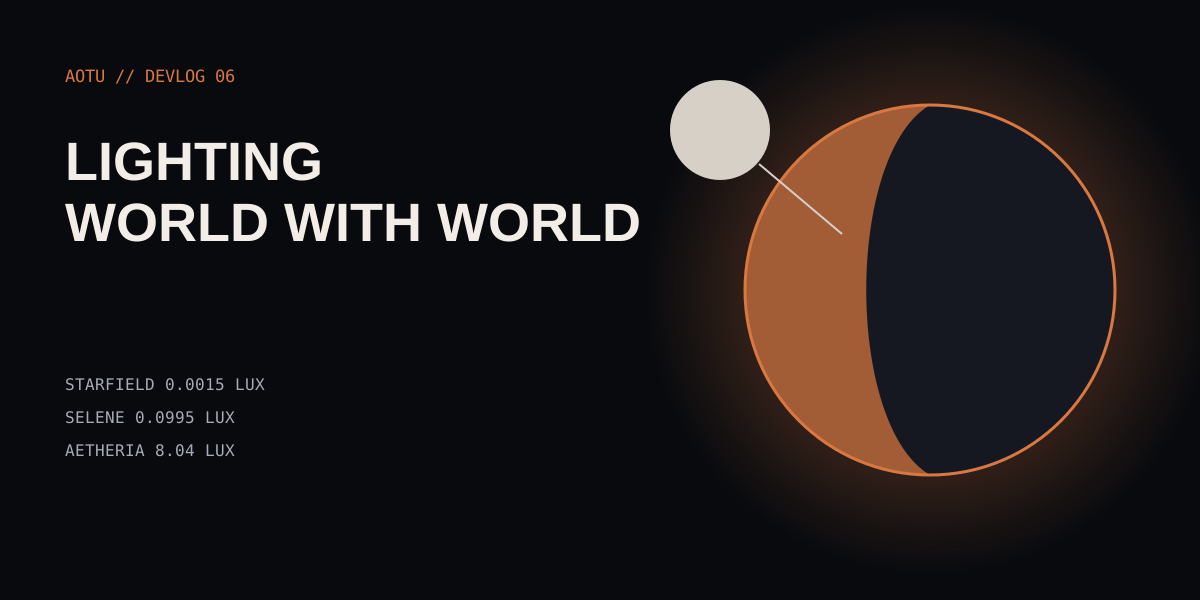
Night on a moon is not simply “the sun light is off.” Aetheria hangs above Selene and contributes light of its own. Selene is visible from Aetheria. Each body must illuminate the other, shadow itself and pass through eclipses without becoming a flat directional fill.
During 7–8 May, Ashes of the Unbound gained the first measured celestial night-lighting path. The important word is measured. Screenshots can look plausible while the system underneath them is wildly inconsistent.
Measured lighting targets
The work used three reference anchors:
- a 0.0015-lux starfield baseline;
- approximately 0.0995 lux from Selene on Aetheria;
- approximately 8.04 lux from Aetheria on Selene.
They are not intended to turn the game into an astrophysics simulation. They give the rendering system contracts with useful relative scale. Aetheria should be a much stronger night source from Selene than Selene is from Aetheria, and both should remain distinct from the background starfield.
Without anchors, every exposure change risks becoming an accidental redesign of the universe.
Receiver self-shadowing
A celestial contribution cannot simply shine across the entire receiver body. The body occludes itself.
For a point on the surface, the renderer needs the relationship between the surface position, receiver centre and light-source direction. The result should produce a curved terminator and a dark far side. Add another occluding body and the eclipse boundary should also follow the geometry rather than appear as a screen-space stripe.
This work introduced the receiver and source data needed to evaluate those relationships per pixel. It also exposed how dangerous it is to trust a plausible preview without validating the actual receiver point used by the shader.
Aetheria from Selene
The Selene night test established the stronger 8.04-lux contribution from Aetheria. It creates readable terrain and a visible direction to the light without pretending the moon is in daylight.
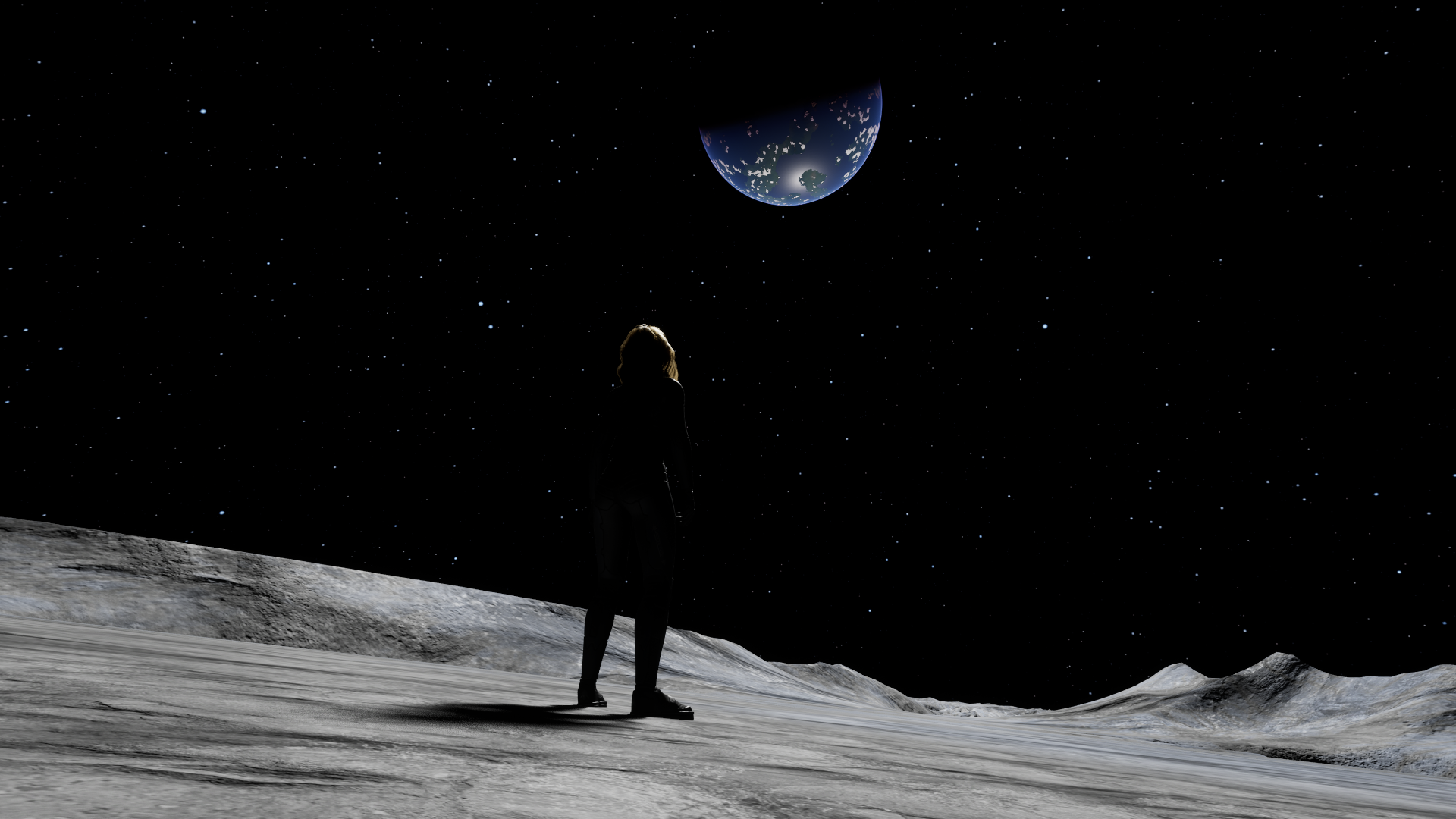
The frame is more than a beauty shot. It is tied to an active test state and a known lighting target, making it useful as a regression reference.
Selene from Aetheria
The reciprocal path is intentionally weaker. At the Aetheria sunset anchor, Selene’s contribution is visible without flattening the remaining atmospheric and surface response.
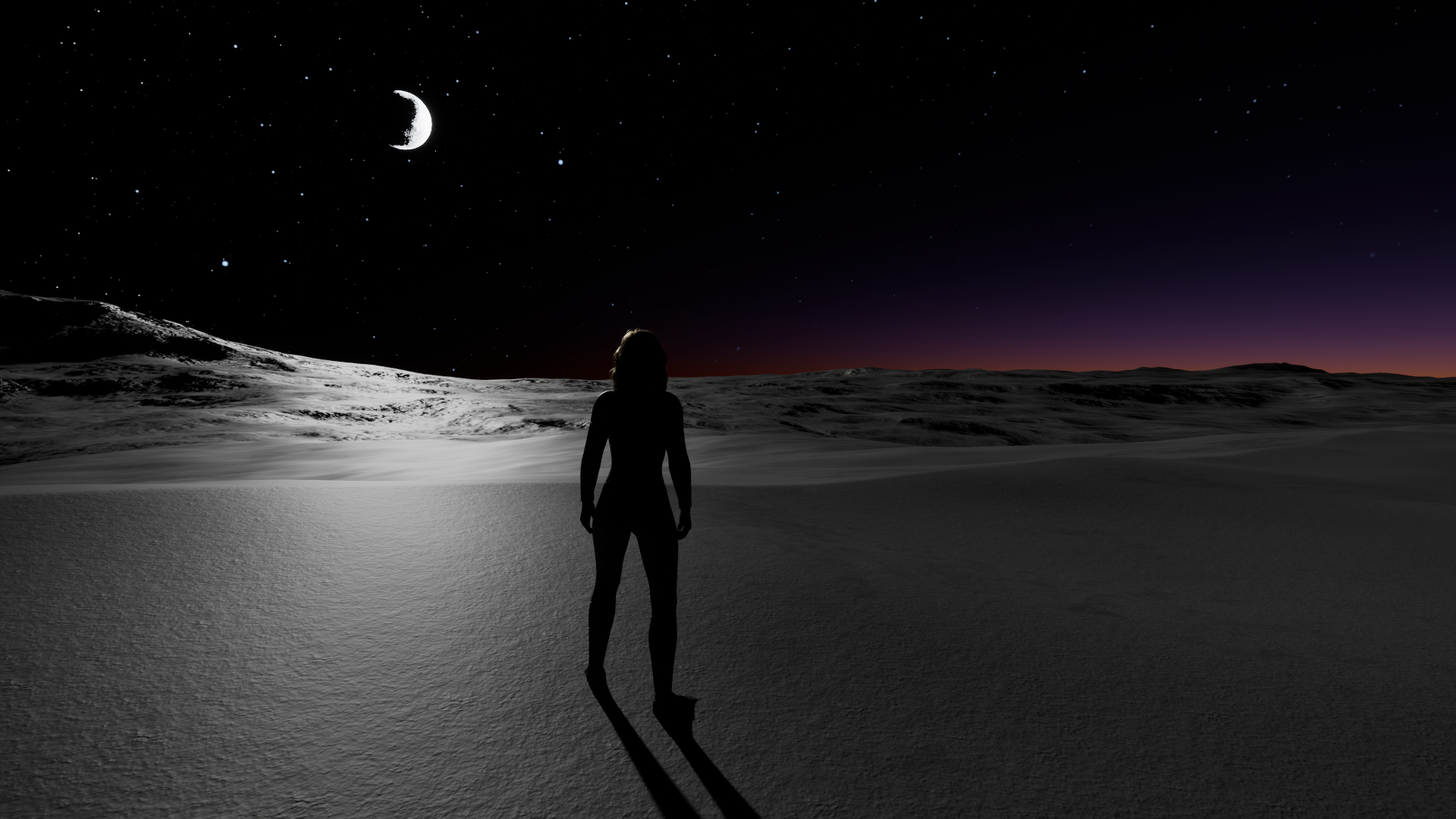
The mismatch in scale between the two directions is a feature. Treating both bodies as the same generic fill light would be easier and wrong.
Testing character materials and hair
The character’s hair became another receiver test. It can be tempting to solve celestial shadowing for opaque terrain and declare the problem complete, but character materials and secondary geometry need to participate in the same light policy.
If hair ignores the night-side rules, it glows against a correctly dark character. If it uses a different position basis, it can cross an eclipse boundary at a different time. The visually small mismatch reveals a larger disagreement about frame or shadow inputs.
Keeping activation in the project
The celestial path was designed as an engine capability that remains disabled by default. Ashes of the Unbound opts into it explicitly.
That boundary keeps a specialized rendering feature from silently changing every project using the engine build. The engine provides the mechanism; the project decides whether its worlds, materials and validation data satisfy the contract.
This separation became important during the following blackout investigation. A diagnostic switch could bypass part of the occlusion work, but that did not make bypassing it an acceptable production policy.
The blackout that followed
By 8 May, the reference scenes produced useful measured results. The next test configuration caused Selene’s night side to disappear completely.
The uniforms were correct. The ray mathematics was correct. Disabling a branch brought the image back. It looked like an occlusion problem, but the real defect was one level more fundamental: the shader was evaluating the right equation at a fictional point.
That investigation became The Moon Disappeared Because Its Pixels Were in the Wrong Place.